Echoes of Aurora
6. april 2025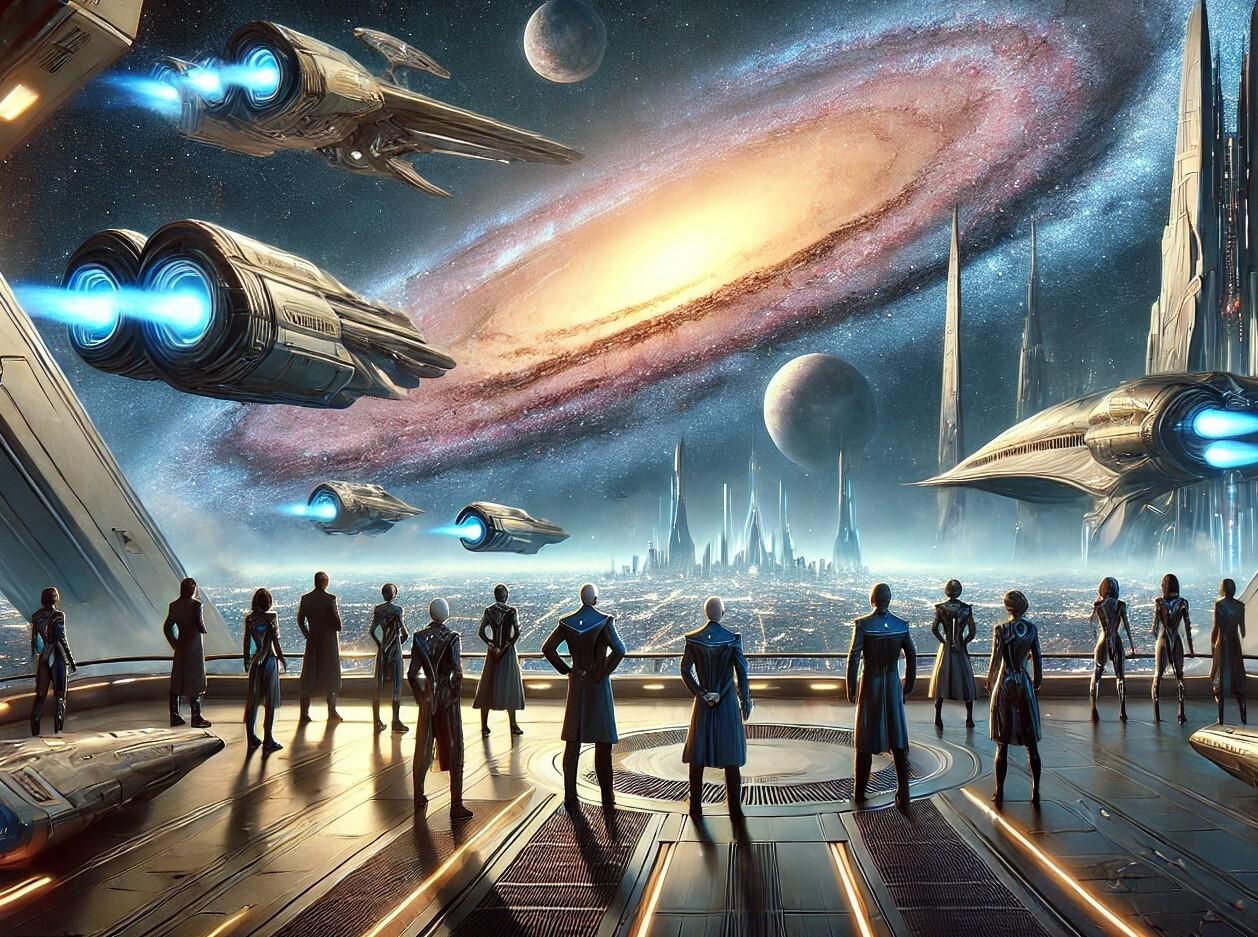
Chapter 1: Into the Great Beyond
In the vast expanse of the Andromeda Galaxy, humanity took its first tentative steps beyond the Milky Way. After centuries of internal conflicts, ecological disasters, and remarkable technological triumphs, the human race had united under a common banner: peaceful exploration. The day they activated their first quantum relay station, connecting them to a previously undetected galactic network, everything changed.
Chapter 2: Joining the Galactic Council
Upon joining the Galactic Council — a sprawling interstellar assembly of thousands of species — humans found themselves seen as intriguing curiosities, peaceful newcomers welcomed warmly by species as diverse in philosophy as in biology. The Lumari, ancient beings radiating tranquility, became immediate allies, guiding humanity through diplomatic nuances and cultural exchanges. On the other side were the Xorathi, a fiercely militaristic empire whose history was marked by dominance and conquest.
Initially, the Xorathi viewed humans as harmless, almost primitive. After all, humanity broadcasted a philosophy of peace and exploration. Human ambassadors, scientists, and diplomats earnestly participated in Galactic Council activities, exchanging technology, culture, and knowledge — but never military capabilities.
Chapter 3: The Diplomats
For decades, humanity thrived in their role, becoming the diplomatic glue in various interspecies disputes, their deep curiosity winning them admiration. Humans championed diplomacy with unparalleled vigor, hosting diplomatic summits and mediating disputes between previously irreconcilable species. They built neutral stations specifically designed for peace negotiations, featuring environments tailored to facilitate calm, open dialogue.
Ambassador Elena Trevino, renowned across species for her empathetic diplomacy, led countless successful mediations, resolving centuries-old conflicts. Her most notable success was the negotiation between the aquatic Zephorans and the avian Skrilith, whose disagreement over planetary boundaries nearly sparked an interstellar war. By highlighting shared values and mutual benefits, she crafted a lasting agreement that fostered peaceful coexistence.
Chapter 4: Aurora, Beacon of Harmony
Central to humanity’s diplomatic and cultural achievements was the colony of Aurora, a gleaming jewel of human civilization nestled among verdant forests and crystalline lakes. Established as a testament to peaceful coexistence, Aurora embodied the ideals of unity, diversity, and interspecies harmony. The colony thrived on a world gifted with natural beauty, carefully preserved through human ecological engineering that blended seamlessly with the planet’s ecosystems.
Aurora’s capital city, Solis, exemplified humanity’s dedication to harmonious living. Its architecture, inspired by human artistic traditions and enhanced by interspecies design philosophies, featured flowing organic structures that blended effortlessly with the surrounding environment. Vast gardens intertwined with public spaces, designed to accommodate visitors from numerous species, providing comfort and accessibility for beings of all forms. The Grand Diplomatic Forum, the city’s centerpiece, hosted frequent interstellar diplomatic events, establishing Aurora as a nexus of peaceful diplomacy.
Chapter 5: Cultural Ambassadors
Human cultural exchange programs flourished, promoting interspecies understanding through art, music, and shared scientific endeavors. The “Harmony Initiative,” a human-founded project, became wildly popular, creating immersive experiences where various species could live temporarily on each other’s worlds, fostering empathy and understanding at profound levels.
Additionally, humans spearheaded numerous environmental initiatives, helping other species preserve their planets and ecosystems through advanced terraforming and ecological restoration technologies. Their dedication to protecting biodiversity earned them admiration even from skeptical species, showcasing humanity’s genuine commitment to peace through preservation.
Chapter 6: Shadows of Doubt
Yet, humans faced continuous skepticism from militaristic factions like the Xorathi. Determined to maintain peace, humans consistently demonstrated restraint even when provoked, choosing instead to rely on diplomacy. They carefully avoided actions that could escalate tensions, always prioritizing negotiation and dialogue.
Despite humanity’s unwavering diplomatic efforts, Xorathi hostility steadily escalated. Initial skepticism turned into contempt, and eventually into outright hostility. Human diplomats, led by Ambassador Trevino, tirelessly attempted to defuse tensions, emphasizing mutual respect and understanding. Countless diplomatic missions ventured into Xorathi space, offering peaceful cooperation, joint ventures in exploration, and technological exchange focused solely on peaceful applications. Each overture, however, was met with increasing disdain.
Xorathi military demonstrations grew frequent, aggressive, and dangerously close to human territories. They staged provocative war games near neutral zones and human outposts, testing humanity’s patience and response. Human diplomats raised concerns repeatedly in the Galactic Council, urging intervention to curb these aggressive actions. Yet, the Xorathi continually brushed aside diplomatic warnings, dismissing them as evidence of human cowardice and weakness.
In one notable incident, a human diplomatic vessel was detained by a Xorathi fleet in neutral space, sparking a diplomatic crisis. Humanity responded with composed yet firm diplomatic pressure, demanding the vessel’s immediate release. The council watched anxiously as humans chose restraint and dialogue, meticulously avoiding any escalation. After tense negotiations, the vessel and crew were returned unharmed, but the incident marked a significant turning point in Xorathi hostility.
Ambassador Trevino, recognized for her patience and diplomatic acumen, traveled directly to the Xorathi homeworld to personally negotiate with their High Command. Her mission emphasized shared prosperity, mutual benefits of peace, and the devastating costs of war. Despite her eloquence, the Xorathi leadership dismissed her appeal, asserting that strength alone determined survival and superiority. It became clear that diplomacy was viewed as weakness, a strategic mistake humanity struggled to correct.
As tensions continued to rise, human colonists and researchers increasingly found themselves harassed or threatened by Xorathi patrols in neutral territories. Xorathi propaganda openly painted humans as dangerous deceivers, pretending peace to mask sinister intentions. The Galactic Council, alarmed yet cautious, continued to advocate diplomatic resolution but struggled to curb the growing animosity.
Privately, humanity began discreet preparations for potential conflict while publicly advocating peace more fervently than ever. They hoped for the best yet quietly prepared for the worst, painfully aware that their carefully preserved peace hung precariously on the edge of conflict.
Chapter 7: The Xorathi Offensive
When the Xorathi, interpreting human reluctance to showcase military might as vulnerability, launched their devastating assault on Aurora, they came prepared for total annihilation. The Xorathi fleet, massive and daunting, included battleships capable of planetary bombardment, heavily armored dreadnoughts, and squadrons of agile attack craft. Aurora, shining brilliantly as a testament to interspecies cooperation, appeared defenseless.
The flagship of the Xorathi fleet was the Indomitable Wrath, an immense dreadnought bristling with advanced weaponry and shielded by thick layers of reinforced armor. Measuring several kilometers in length, this vessel symbolized the Xorathi’s philosophy of dominance through overwhelming force. Its primary armament, a powerful energy cannon capable of reducing entire continents to molten slag, exemplified the ruthless efficiency prized by the Xorathi.
Accompanying the flagship were several Titan-class battleships, designed specifically for planetary siege operations. These battleships, though smaller than the Indomitable Wrath, were equally terrifying. Their hulls were covered in massive gun batteries, missile silos loaded with thermonuclear warheads, and plasma emitters capable of burning through planetary atmospheres. Each battleship carried a crew of thousands, hardened soldiers indoctrinated from birth to believe in the superiority and inevitability of Xorathi dominance.
Supporting these formidable vessels were swarms of agile attack craft, known as Ravagers, designed for rapid deployment and ruthless precision. Small, maneuverable, and heavily armed, these fighters and bombers could penetrate enemy defenses with astonishing speed. Their pilots were among the most elite of the Xorathi warriors, conditioned through rigorous, often brutal training regimens that emphasized aggression, tactical precision, and merciless combat efficiency.
In addition to their devastating firepower, the Xorathi fleet was equipped with advanced electronic warfare systems. These devices were designed to disrupt enemy communication, targeting systems, and defensive countermeasures, leaving their opponents blind and helpless in the face of overwhelming attack. The fleet’s technological prowess extended to its sophisticated shielding systems, capable of absorbing or deflecting vast amounts of damage, ensuring the fleet’s near-invulnerability during assaults.
Strategically, the Xorathi favored overwhelming force combined with ruthless aggression. Their tactics included saturation bombardments designed to annihilate enemy defenses swiftly, followed by ground assaults utilizing massive, heavily armored troop carriers. Each ground assault unit consisted of genetically enhanced infantry, supported by advanced mechanized units and formidable war machines.
The preparations for the assault on Aurora had been meticulously calculated. The Xorathi High Command, confident in their assessment of humanity as weak and defenseless, saw this attack as an opportunity not only to claim new territory but to deliver a stark warning to other species in the Galactic Council. Victory over Aurora would reinforce their reputation for dominance and deter future challenges to their authority.
As the fleet emerged from hyperspace near Aurora, their presence alone radiated intimidation. The sleek, dark-hulled vessels moved with calculated precision, silently communicating their intent through their formations: an encirclement designed to prevent any chance of escape or reinforcement. Each vessel maintained tight coordination, their commanders executing plans rehearsed countless times in simulations and previous campaigns.
Yet, unbeknownst to the Xorathi, Aurora was not as defenseless as they presumed. Beneath its peaceful veneer lay preparations humanity hoped never to reveal but was fully ready to deploy if pushed to the brink.
Chapter 8: Awakening the Sleeping Giant
As the Xorathi fleet closed in, their scanners suddenly detected a surge in energy signatures from seemingly nowhere. Human defensive technologies, hidden in plain sight for decades, activated instantaneously. Immense orbital defense arrays rose from concealed positions beneath Aurora’s tranquil oceans and lush forests. Their weapons, previously unseen in council discussions, discharged energy beams powerful enough to vaporize entire Xorathi warships in seconds.
The humans deployed their warships from stealth, sleek vessels previously unknown to the Galactic Council, each armed with weapons capable of piercing the most advanced shielding the Xorathi possessed. The engagement was brutally efficient. Human military strategy was swift, ruthless, yet oddly restrained, targeting enemy vessels with pinpoint accuracy, minimizing unnecessary casualties but completely obliterating offensive capabilities.
Chapter 9: Humanity’s Hidden Power
The Xorathi commanders quickly realized the horrifying truth: humanity’s destructive capacity dwarfed anything the galaxy had ever witnessed. Human weapons systems — energy disruptors capable of tearing apart atomic structures, antimatter warheads with apocalyptic destructive potential, and gravity manipulation devices able to crush entire fleets — had remained hidden not out of weakness, but due to their incomprehensible power.
Humanity’s choice of peace stemmed from a profound historical trauma. Generations before their arrival at the Galactic Council, humans had nearly destroyed themselves through war, violence, and unrestrained technological escalation. The scars from nuclear devastation, ecological collapse, and brutal conflicts remained etched deeply into human consciousness, a collective memory that guided their decisions.
Historical figures and visionary leaders had emerged from humanity’s darkest moments, preaching philosophies of unity, reconciliation, and peace. Movements emphasizing education, empathy, and cooperation gradually replaced the old systems built upon division and fear. Humans developed an almost spiritual reverence for peace, a belief that their intelligence and strength could only be justified if guided by compassion and ethical responsibility.
This cultural transformation was deeply ingrained into every facet of human society, from education systems that prioritized conflict resolution to governance structures designed around democratic principles of equality and fairness. Humanity believed that their true greatness lay not in their technological prowess or destructive potential, but in their ability to rise above aggression and violence.
Their hidden power served as both a safeguard and a symbol of their greatest fear — that the horrors of their past might be repeated. By keeping their devastating capabilities concealed, humanity reminded itself and others of the weight of responsibility that accompanied such power. Their restraint was not mere strategy, but a solemn vow, a promise to future generations never to unleash the devastation of the past again.
Chapter 10: Guardians of Peace
This startling revelation forced the Xorathi into a humiliating retreat, their fleet severely crippled, their pride shattered. The Galactic Council, initially shocked by humanity’s brutal effectiveness in battle, quickly understood the deeper wisdom behind humanity’s restraint. The council embraced humans not just as formidable warriors but as wise custodians of an immense destructive potential that, in less thoughtful hands, could end civilizations.
The encounter with the Xorathi had profoundly tested the conviction to preserve peace. Despite the necessity of revealing their destructive capabilities to safeguard Aurora, humanity had emerged with their moral compass intact. Rather than feeling pride in military triumph, humans expressed regret over the forced demonstration of their hidden power. They reaffirmed their commitment to diplomacy, determined to prevent such a display from ever becoming necessary again.
Ambassador Elena Trevino became an iconic voice in reinforcing this commitment across the galaxy. Following the Xorathi conflict, she tirelessly advocated for an interstellar understanding built on compassion, mutual respect, and ethical responsibility. Her speeches, filled with wisdom and insight born of personal experience, resonated deeply with many species, galvanizing widespread support for a new era of intergalactic peace.
In one memorable address to the Galactic Council, Ambassador Trevino captured humanity’s enduring ethos:
“We carry within us the power to end worlds, yet we choose to nurture them instead. Our history has taught us that violence is easy, seductive even — but peace demands the strength of character and unyielding courage to rise above our basest instincts. We do not wield power to dominate, but to protect. Our greatest weapon is not found in our arsenal, but in our capacity for compassion, understanding, and forgiveness. Let this be our legacy — a universe not ruled by fear, but united by peace.”